The Offloading Ladder
This is my first preprint, and my first conceptual piece.
As we see AI taking over student work (and of course professional work), I have been thinking about a good way to think about its integration. Going back to theories in education (and recent studies on AI and learning), I drafted this piece and am sharing it as a preprint. It grew out of two earlier posts here, The Radiology Lesson and Beyond the Panic.
The big idea is in the figure below. Tech-human partnership has always existed, but with AI, the cognitive partnership can be dangerous as well as helpful. I suggest that offloading happens on a ladder, and a task’s order depends on the person: it is high order while they still have to figure out what to do, and low order once they know how. Once a task becomes low order for a person, they can offload that part to technology, until they reach the core, which depends on the person and the job.
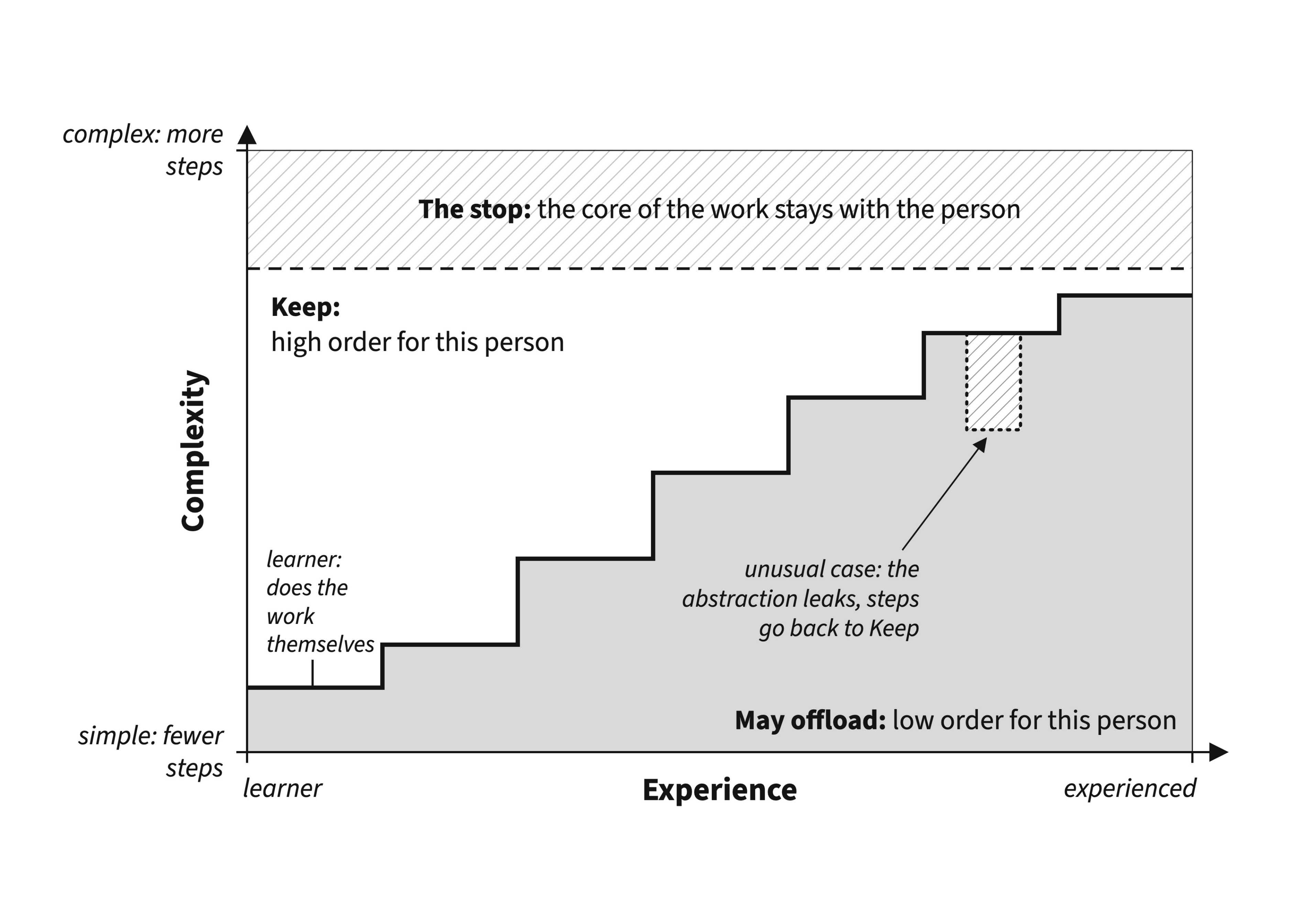
For learners, classrooms and courses need to determine the core and keep it off AI. AI companies need a better way to protect human learning.
Preprint (EdArXiv): Akcaoglu, M. (2026). The Offloading Ladder: How Experience Changes What Learners and Practitioners Should Hand to Artificial Intelligence. https://doi.org/10.35542/osf.io/ys2fu_v1
How I used AI. Since the piece is about AI, let’s talk about it too. As I make the case in the paper, AI usage also ranges from low order to high order, and I believe I kept the high-order work for myself. I started from my initial idea and outline. I used Undermind to search the literature and Claude Code to gather notes from my readings (my highlights in Zotero). Over many sessions, I built the paper step by step, creating each paragraph and argument and using Claude Code to shape paragraphs from my arguments and reading notes, and I edited and rewrote each draft along the way. Claude Code also checked references and accuracy. I used Claude Design to draw the figure. Going back to the ladder, I kept the core (the idea and editorial ownership), and Claude Code helped with tasks that were low order for me, like pulling my highlights into my outline.